Beryl Stapleton
The Hound of the BaskervillesBeryl Stapleton enters Dr. Watson’s account as an arresting presence on a lonely moorland path and, more consequentially, as the bearer of a warning she cannot straightforwardly explain. She urges Watson to return to London and never come back to the moor, then later says that she mistook him for Sir Henry and that her concern was intended for Sir Henry alone. The change makes her both a possible source of protection and a figure whose knowledge and motives remain uncertain in these encounters.
Identity and First Encounter
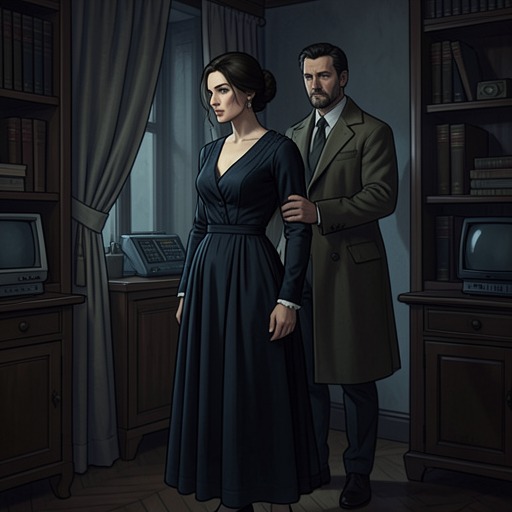
Watson recognizes Beryl as Miss Stapleton, the woman he has heard described as a beauty. He sees her approaching from the direction of the smoke that marks Merripit House, after the dip of the moor has concealed her until she is close. Her appearance is distinguished from Stapleton’s: he is described as light-haired and gray-eyed, while she is darker, tall, slim, and elegantly dressed. Watson also notices her proud, finely cut face and dark, eager eyes. His account presents her as a striking contrast to the brother beside whom he believes she stands, but it is Beryl’s urgency, rather than her appearance, that redirects the encounter.
At the moment she approaches, Stapleton has rushed after a small insect toward the treacherous mire, moving from tuft to tuft with a net. Beryl’s attention is first on him; she then turns quickly toward Watson and warns him to go back to London immediately. The abruptness of the intervention interrupts Watson’s expectation of an ordinary meeting. He is left staring at her, while she taps her foot impatiently and presses him to heed her without supplying an explanation.
The Warning and Its Retraction
Beryl insists that Watson leave the moor and never set foot there again, but says she cannot explain why. Her low, eager manner and the intensity with which she appeals to him make the warning seem deliberate, not casual. She asks him to say nothing to Stapleton, then quickly changes the subject by asking Watson to fetch an orchid. That pivot allows the encounter to continue in Stapleton’s presence without openly revealing what she has just told Watson.
Watson does not accept the warning as a matter concerning only himself. He is on the moor in connection with Sir Henry, and he tells Beryl that Sir Henry’s welfare matters directly to him. When Watson leaves rather than stay for lunch, Beryl takes a shortcut and reaches the path ahead of him. She says she ran all the way to intercept him, had no time to put on her hat, and wanted to apologize: she had mistaken him for Sir Henry. She now says her warning did not apply to Watson.
That explanation does not settle Watson’s concern. He remembers the urgency in her voice and asks what danger she meant, offering to convey the warning to Sir Henry. Beryl first dismisses the matter as a woman’s whim, saying that she cannot always give reasons for what she does. When pressed, she offers a different account: she and Stapleton knew Sir Charles well because his favorite walk across the moor led to their house. Sir Charles, she says, had been deeply affected by the family curse; after his death, she feared that Sir Henry, another member of the family, would face danger. She identifies the hound story as the danger she had in mind. Her account gives the warning a stated cause, while leaving unresolved why she initially addressed Watson as if he himself must escape.
The Moor as a Source of Risk
The landscape surrounding Beryl’s intervention gives her appeal a concrete setting. A map discussed by Sherlock Holmes places Baskerville Hall at the center of the district, with Yew Alley, Grimpen, and the isolated dwellings around it; Merripit is identified as the possible home of the naturalist Stapleton. The map describes a sparse settlement surrounded by a desolate moor, making the route between houses and the open ground part of the danger rather than a neutral backdrop.
Other encounters in the same landscape show how easily movement across it can become hazardous. Stapleton points out bright green patches on the northern plain and says that the apparently inviting ground has cost lives. He also warns Watson that crossing the moor would be unlikely to end safely unless he remembered its complex landmarks. These are Stapleton’s statements, not knowledge Beryl claims for herself, but they establish why a warning to leave the district carries more weight than a simple request to avoid a particular path. The moor is difficult to read, and its hazards are not reliably visible to an inexperienced traveler.
Narrative Role and Uncertainty
Beryl’s intervention changes the terms of Watson’s visit. Before she appears, the moor’s sadness and the story surrounding the Baskerville family have impressed him, but his account distinguishes those general unease-producing impressions from her specific, earnest warning. Her words give his unease a human source and direct it toward the safety of Sir Henry. Yet the correction that follows redirects the warning away from Watson and frames it as an attempt to protect Sir Henry from the danger she associates with the hound.
The contrast between her urgent first appeal and her later explanation remains important. Beryl provides a connection between Sir Charles’s fear of the family curse and the threat facing Sir Henry, and she confirms that the hound story informs her concern. At the same time, she withholds an explanation when first asked, requests secrecy from Stapleton, and then minimizes her own warning before giving its rationale. In the supplied encounters, the account ends without showing whether Sir Henry receives her warning or whether her explanation resolves Watson’s suspicions. Beryl’s role here is therefore defined by disclosure and retreat: she brings danger into view, but does not yet make its full nature clear.